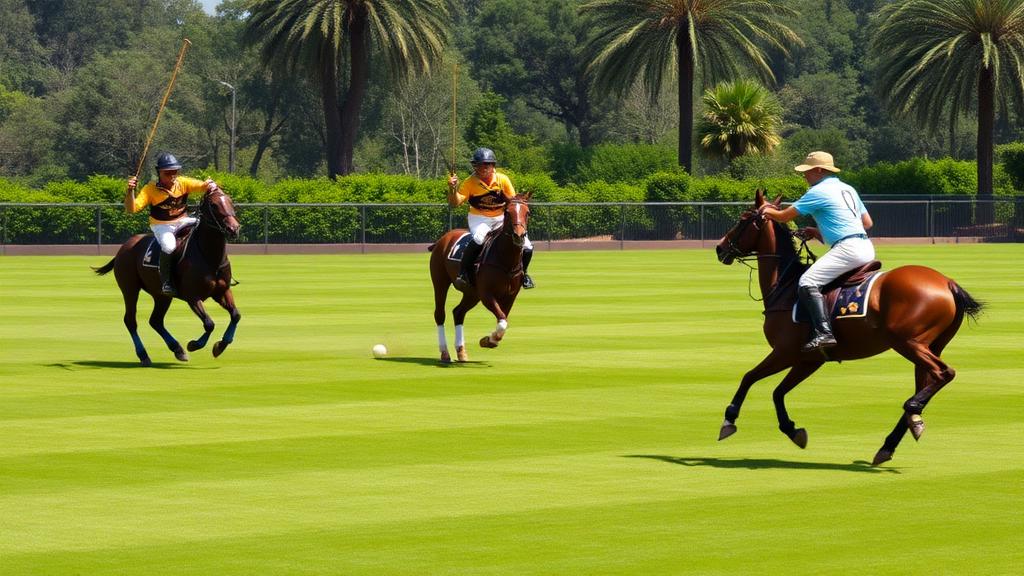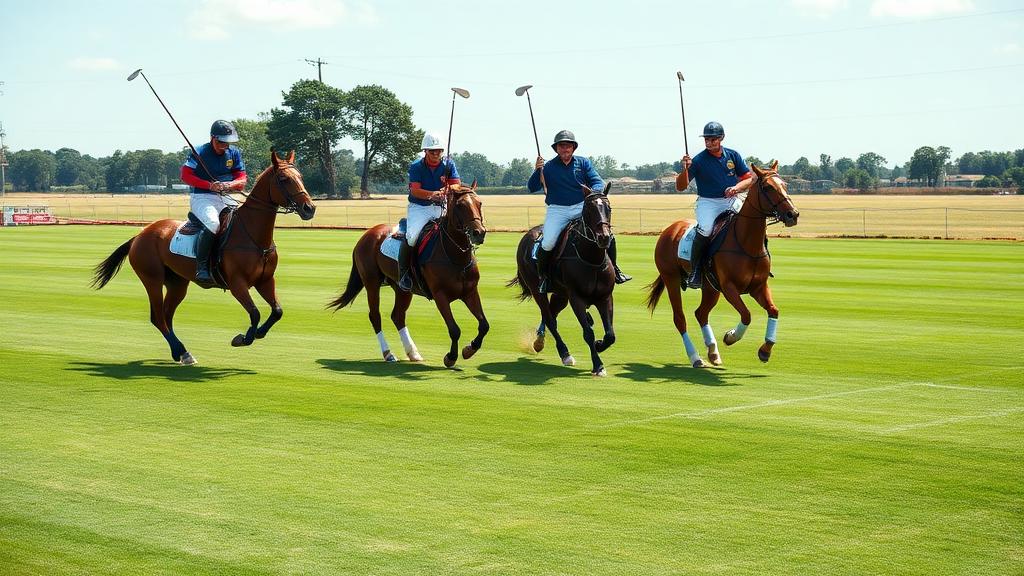
Polo Swing Fundamentals: Building a Solid Foundation
Master the four basic swings in polo with detailed breakdowns, common mistakes to avoid, and drills for improvement.
# Mastering the Polo Swing
The polo swing is the foundation of everything you'll do on the field. A technically sound swing allows you to hit with power, accuracy, and consistency while maintaining balance on your horse. This guide breaks down the four essential swings every polo player must master.
## Understanding Swing Mechanics
Before diving into specific shots, it's crucial to understand the fundamental principles that govern all polo swings:
**The Pendulum Principle**: Your arm and mallet should move as a single unit, swinging from your shoulder like a pendulum. Power comes from this fluid motion, not from wrist action or muscling the shot.
**Eye on the Ball**: Keep your eyes fixed on the ball throughout the swing. Looking up too early is the most common cause of missed shots.
**Body Position**: Your body should remain relatively quiet while your arm does the work. Excessive body movement disrupts your balance and timing.
## Grip Technique
The correct grip is essential for control and power:
- Hold the mallet as you would shake someone's hand
- Your thumb should wrap around the handle, pointing down towards the mallet head
- Grip firmly but not tensely—tension kills fluidity
- The sling should wrap around your wrist for safety
## The Four Basic Swings
### 1. Offside Forehand
The offside forehand is the most natural and powerful shot for right-handed players. You hit the ball on the right side of the horse, swinging forward.
**Technique**:
- Rotate your shoulders to the right as you prepare
- Raise the mallet behind your right shoulder
- Swing down and through in a smooth arc
- Follow through towards your target
- Your body weight should shift slightly forward with the swing
**Common Mistakes**: Hitting with a bent arm, looking up before contact, and stopping the follow-through.
### 2. Offside Backhand
The offside backhand hits the ball backwards on the right side—essential for defensive plays and quick direction changes.
**Technique**:
- Turn your body to look behind your right shoulder
- Swing the mallet back and down
- Make contact when the ball is level with or behind your hip
- Follow through completely
**Common Mistakes**: Not turning the body enough, insufficient follow-through, and mistiming the contact point.
### 3. Nearside Forehand
The nearside forehand is played on the left side of the horse, hitting forward. It's more challenging because you're reaching across the horse.
**Technique**:
- Lean your upper body to the left while keeping your legs secure
- Keep the mallet on a flat plane across the horse
- Swing forward and down, making contact ahead of the horse's shoulder
- Maintain your balance throughout
**Common Mistakes**: Leaning too far and losing balance, hitting into the horse's legs, and scooping rather than striking.
### 4. Nearside Backhand
Often considered the most difficult shot, the nearside backhand requires excellent balance and coordination.
**Technique**:
- Rotate your upper body to look over your left shoulder
- Keep the mallet flat and swing backwards
- Make contact when the ball is behind your left hip
- Complete the follow-through while regaining your central balance
**Common Mistakes**: Insufficient body rotation, hitting the horse, and poor timing.
## Practice Drills for Home
You don't need a horse or even a polo field to improve your swing:
**Mirror Work**: Practice your swing in front of a mirror to check your form. Focus on keeping your arm straight and your motion fluid.
**Wooden Horse Sessions**: If your club has a wooden horse, spend extra time on it. Hit hundreds of balls to build muscle memory.
**Shadow Swinging**: Even without a mallet, practice the motion of each swing. Focus on shoulder rotation and arm extension.
**Ball Toss Drill**: Have someone roll balls to you while you stand on a platform. Practice timing your swing to meet the moving ball.
## Building Power and Accuracy
As your technique improves, focus on:
- Timing your swing with the horse's stride
- Hitting through the ball, not at it
- Using the horse's momentum to add power
- Developing court awareness while maintaining swing form
Remember: technique before power. A well-timed, technically correct swing will always outperform a muscled, poorly-timed hit. Master the fundamentals first, and power will follow naturally.